Fluorine-free · High
Wax-emulsion grease barrier, no fluorochemicals added
70°C oil
Up to 8 h oil hold
Factory dataEU / UK suitable
Use for: Sushi, salads, warm rice dishes up to 70 °C
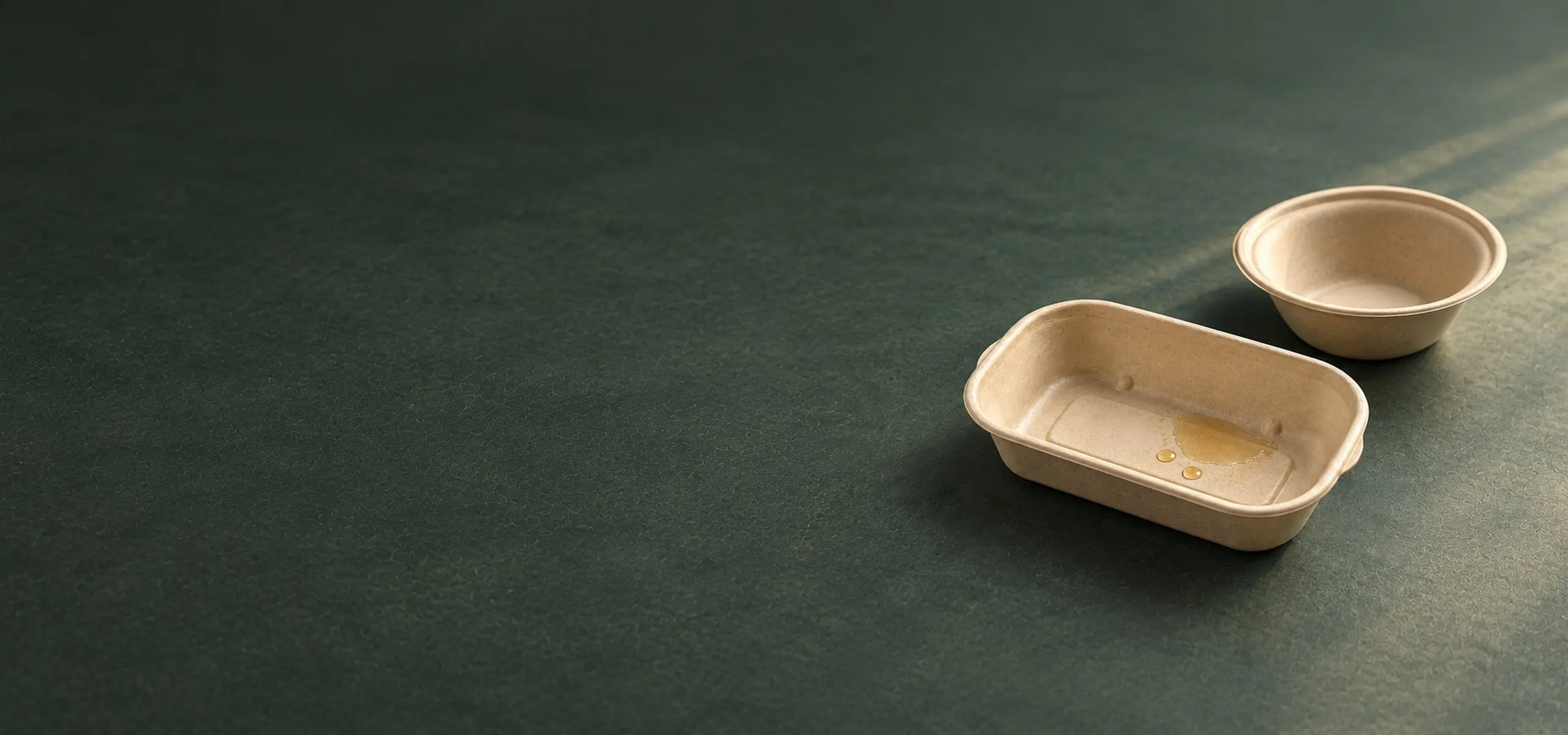
Jirun makes three grease barrier grades for bagasse tableware. The fluorine-free grade uses a wax emulsion with no fluorochemicals added and is rated by the factory for oil up to 70 °C (high-temperature version) or 50 °C (low-temperature version) and for hot liquid at 70 °C, checked over about 3.5 hours; food with both oil and water, such as soup with oil or fried food, holds for 1–2 hours. It is not for soup straight from the pot or freshly fried food. It is the grade we supply to the EU, UK and Australia. The standard fluorinated grade resists oil up to 120 °C but is not supplied to the EU or UK. Jirun does not make laminated or spray-coated grades.
All figures are factory data. Each will be replaced by a third-party report number as results are issued.
Swipe for all columns →
| Grade | Barrier | Oil resistance | Oil hold time | Hot water | Oil and water food | Contains plastic | EU / UK | Evidence |
|---|---|---|---|---|---|---|---|---|
| Fluorine-free · High | Wax-emulsion grease barrier, no fluorochemicals added | 70 °C | Up to 8 h (factory); industry typical ~30 min | 70 °C, about 3.5 h | 70 °C, 1–2 h | No | Yes | Factory data |
| Fluorine-free · Low | Wax-emulsion grease barrier, no fluorochemicals added | 50 °C | 60 min | 70 °C, about 3.5 h | On request | No | Yes | Factory data |
| Fluorinated · Standard | Fluorochemical oil- and water-repellent additive | 120 °C | 24 h | 100 °C, 24 h | On request | No | No | Factory data |
Temperature bands follow the oil limits in the comparison table.
Factory data Not yet confirmed by a third-party test.
Swipe for all columns →
| Food | Fluorine-free · Low | Fluorine-free · High | Fluorinated · Standard |
|---|---|---|---|
| Chilled food — sushi, salads, fresh meat and produce | Yes | Yes | Yes · non-EU |
| Room-temperature food — bakery, dry snacks | Yes | Yes | Yes · non-EU |
| Warm food up to 50 °C | Yes | Yes | Yes · non-EU |
| Warm food 50–70 °C | No | Yes | Yes · non-EU |
| Hot oily or fried food above 70 °C | No | No | Up to 120 °C · non-EU |
| Soup or sauce straight from the pot, 85–95 °C | No | No | Up to 100 °C · non-EU |
| Hot water-based liquids, poured at up to 70 °C | 70 °C, checked over about 3.5 hours | 70 °C, checked over about 3.5 hours | Up to 100 °C · non-EU |
| Food with both oil and water — soups with oil, sauces, fried food — at up to 70 °C | No | 1–2 hours without seepage | Yes · non-EU |
A fluorinated additive lowers the surface energy of the fibre so that oil cannot wet it, and this effect holds at high temperature. A wax emulsion works by forming a water- and oil-repellent layer on the fibre, which loses effectiveness as the wax softens with heat.
That is why fluorine-free grades are rated at lower temperatures, and why the hold time at a given temperature matters as much as the temperature itself.
Since 12 August 2026, food-contact packaging placed on the EU market must not contain PFAS at or above the limits in Regulation (EU) 2025/40 (PPWR), Article 5: 25 ppb for any single PFAS,250 ppb for the sum of PFAS, and 50 ppm for total PFAS including polymeric PFAS.
There is no stock-exhaustion period. We supply only the fluorine-free grade to EU and UK buyers.
In the factory's test, vegetable oil is heated to 70 °C in a thermostatic oil bath and poured into the product (a meat tray and a rectangular container, two pieces). The products then stand at room temperature, so the oil cools; the base is checked for seepage after about 2, 5.5 and 20 hours. The test was filmed on 20–21 October 2026; there is no third-party report yet, so the figures on this page are marked as factory data. The clips below are the factory's own recording, unedited apart from being split into checkpoints.
Factory data70 °C for the high-temperature fluorine-free grade and 50 °C for the low-temperature grade (factory data). These figures have not yet been confirmed by a third-party test.
Up to 8 hours after oil at 70 °C is poured in, according to factory data for the high-temperature grade. In the factory's test the oil is heated to 70 °C and poured into the product, which then stands at room temperature; it is not kept at 70 °C throughout. Fluorine-free bagasse in the market is commonly quoted at around 30 minutes, so ask any supplier for the test conditions behind their figure. Food that contains both oil and water, such as soup with oil, sauces and fried food, holds for 1–2 hours at up to 70 °C (factory data).
Not straight from the fryer. The high-temperature fluorine-free grade, the grade supplied to the EU, UK and Australia, is rated by the factory for food up to about 70 °C, and freshly fried food such as fried chicken and chips is hotter. Fried food that has cooled to 70 °C or below held for 1–2 hours before oil seeped through the base (factory data). The fluorinated grade is rated by the factory for oil up to 120 °C but is not supplied to the EU or UK. Jirun does not make laminated or spray-coated grades.
No. The grease barrier of the fluorine-free bagasse grade is a wax emulsion. Laminated and spray-coated grades contain plastic; Jirun does not make them.
No. Since 12 August 2026 the EU Packaging and Packaging Waste Regulation (EU) 2025/40, Article 5, limits PFAS in food-contact packaging placed on the EU market. Jirun supplies only the fluorine-free grade to the EU and UK.
Not straight from the pot. The fluorine-free grade is rated by the factory for food up to about 70 °C, so soup at 85–95 °C has to cool before it is packed. In the factory's tests hot water (70 °C, checked over about 3.5 hours) did not seep through, and soup or sauce that contains oil held for 1–2 hours without seepage. The fluorinated grade is rated for 100 °C, checked over 24 hours, but it is not supplied to the EU or UK. These are factory data, not yet confirmed by a third-party test.
Tell us the food, serving temperature and destination market.